BenchScribe
Concept
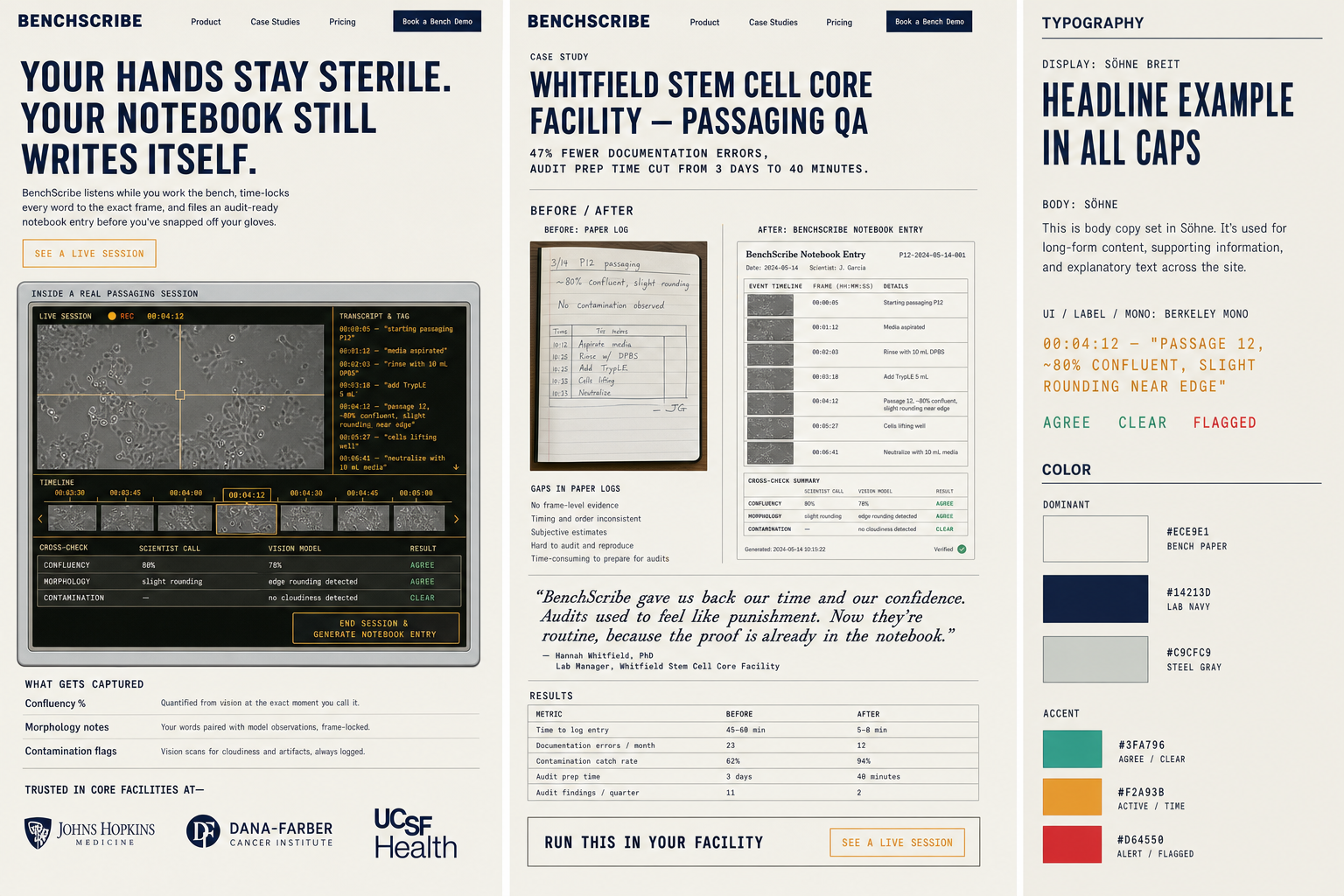
BenchScribe is a hands-free lab assistant for wet-lab biotech work. A small camera and microphone clipped to a biosafety cabinet, bench, or microscope listen to a scientist narrate as they work and watch the physical sample at the same time. Every observation spoken out loud ("passage 12, roughly 80% confluent, slight rounding near the edge") is automatically time-locked to the exact video frame it describes, so the system builds a photo-verified, timestamped record without anyone touching a keyboard — because in a sterile field or gloved cabinet, touching a keyboard is the actual problem being solved.
How it works
- Scientist starts a session by voice ("start passage log for flask 3") — no login screens, no typing.
- A benchtop camera streams continuous video; a voice agent (built on LiveKit, using its new frame-metadata sync capability) tags frames with the transcript segment being spoken at that moment.
- Tagged frames are periodically sent to a vision model for objective cross-checks: confluency percentage, contamination indicators (cloudiness, unusual morphology), colony counts — flagged as agreement or disagreement with the scientist's verbal call.
- At session end, BenchScribe auto-generates a structured, photo-backed lab notebook entry (with audit-ready timestamps) and pushes it via API/CSV into existing ELN systems like Benchling.
- Anomalies (e.g., possible contamination) trigger an immediate spoken alert and flag to the PI or lab manager — a real-time front line for catching problems before they spread.
Why now
LiveKit's new Video Frame Metadata primitive and its recent voice-agent reliability tooling (stable long sessions, "won't go off script" guardrails) make it feasible, for the first time, to reliably sync natural spoken narration to visual evidence in a live session — the exact infrastructure this product needs, without building it from scratch.
MVP scope
- One supported workflow: mammalian cell culture passaging/confluency checks (the most common, highest-frequency wet-lab task).
- Hardware: an off-the-shelf tablet or webcam-on-a-stand — no custom hardware to build or ship.
- Software: LiveKit voice agent pipeline + a vision-model call per tagged frame + a simple export to PDF/CSV and one ELN integration (Benchling API).
- Target customers: academic core cell-culture facilities, early-stage cell therapy/biotech startups, and small CROs — sold as a per-bench monthly subscription.
Unique selling points
- Solves a physical, unavoidable constraint (gloved hands, sterile field) rather than adding another optional AI feature.
- Produces audit-ready, photo-verified documentation instead of after-the-fact memory-based notes — directly reduces compliance risk.
- Small, buildable MVP: existing camera hardware, one narrow workflow, one ELN integration — realistic for a small team to ship and validate in weeks, not months.