Rushes
Concept
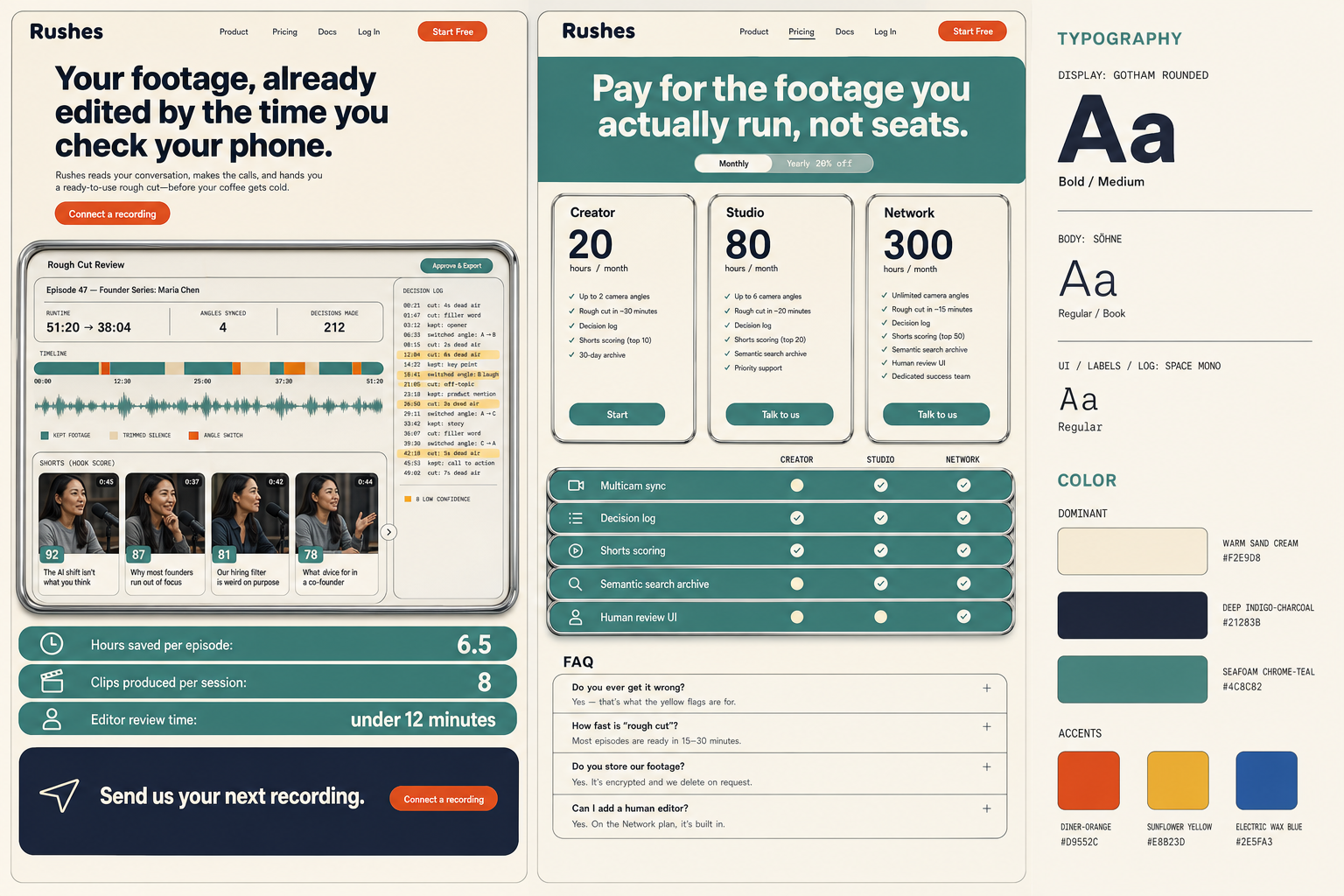
Rushes is an autonomous editing agent for recurring video shows — podcasts, interview series, panel recordings, corporate town halls. When a multicam/multi-track recording session ends (captured live via a LiveKit-based studio or uploaded from any camera/mic setup), a background agent automatically ingests every angle and track, transcribes and semantically tags each segment (speaker, topic, energy, laughter, filler words, dead air), and assembles a full rough cut plus 5-10 vertical short clips scored for hook strength and standalone context — with zero human involvement during the run.
Why now
Recent frontier model releases (Opus 5 / Sonnet 5) are explicitly built for long-running, professional-grade agent work — reliable enough to make hundreds of sequential editing decisions unattended. LiveKit's push into multi-participant, low-latency rooms means remote recording infrastructure is now agent-ready out of the box, closing the gap between "live capture" and "editable footage" with no manual export step.
How it works (MVP)
- Connect a recording source: a LiveKit room webhook (for remote/podcast recordings) or a simple folder/Drive upload for existing multicam footage
- Background agent runs end-to-end: transcribe every track, align multicam angles to a single timeline, tag segments (best take, filler word, silence, energy spike, topic change)
- Agent produces two outputs autonomously: a full-episode rough cut (best angle per speaker turn, dead air and filler words trimmed) and a set of scored short clips for social
- Every AI decision is logged with a plain-language reason ("cut: 4s silence," "switched angle: speaker B reaction," "clip selected: strong hook + resolves in 45s") for auditability
- Human-in-the-loop review UI: a lightweight timeline that highlights only low-confidence decisions for the editor to accept, reject, or nudge — not a full re-scrub. One click exports/publishes.
Unique selling points
- End-to-end pipeline (capture → index → autonomous rough cut → shorts) instead of a single-feature clipper
- Semantic search across a creator's entire raw footage archive, so old sessions become instantly reusable
- Review-by-exception UI cuts editor time to minutes, not hours, by surfacing only what the agent is unsure about
- Transparent decision log builds trust and mirrors the industry's growing emphasis on auditable AI output
- Narrow initial wedge (recurring podcast/interview shows) with obvious expansion into corporate video and webinar teams
Target customer
Podcast production studios, YouTube creators/networks with weekly recurring shows, and small corporate video/marketing teams producing regular interview or town-hall content.