Shelftalk
The Problem
Independent bookstores' best marketing asset — genuine staff recommendations — lives on handwritten index cards taped to shelves. It never reaches the store's website, email list, or social media, and it disappears the moment a book sells out or a staffer leaves. Recreating this content digitally (typing up picks, writing newsletters, building a "staff picks" page) takes time no small store has.
The Idea
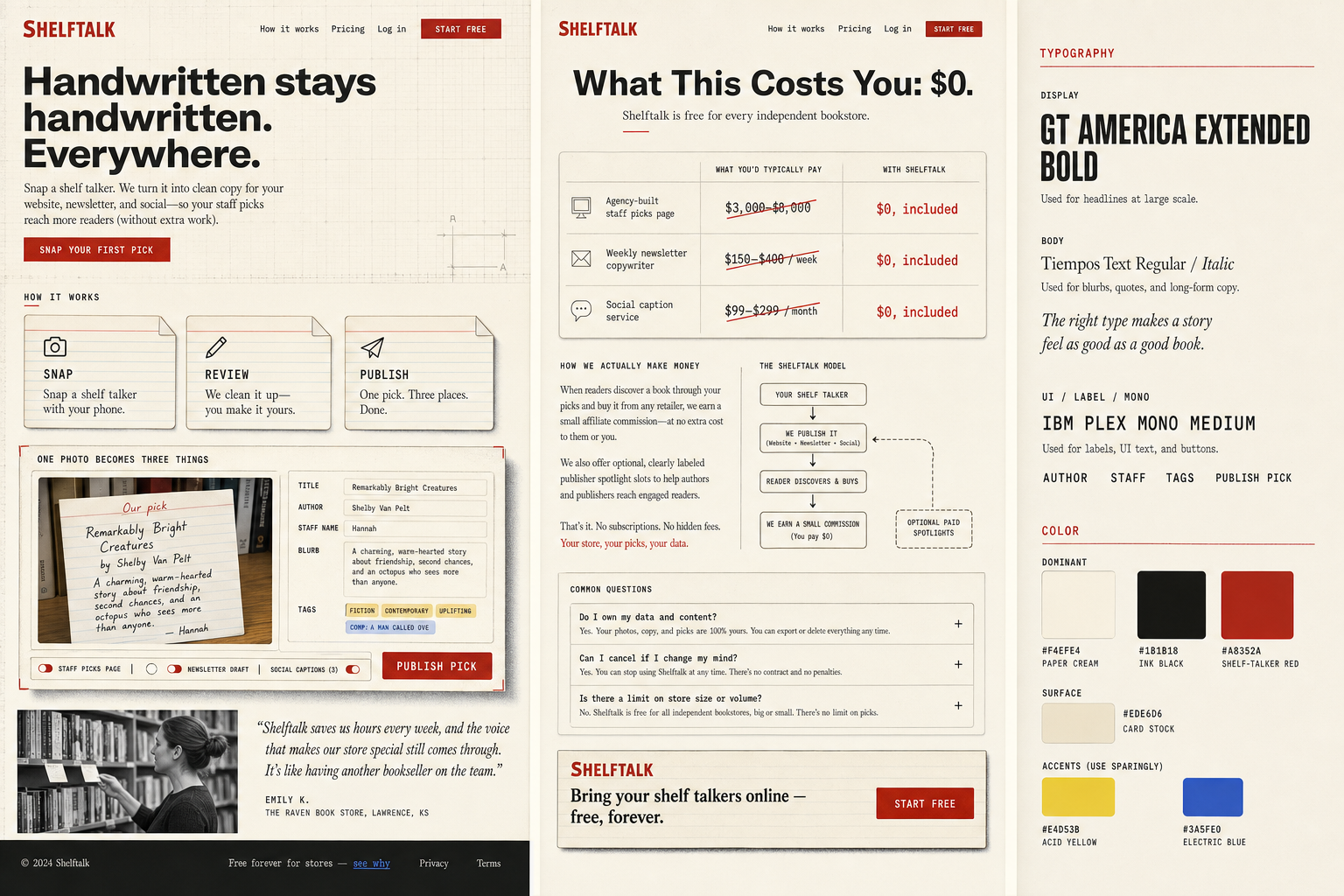
Shelftalk turns a phone photo of a handwritten shelf-talker into structured, reusable, personalized content. A bookseller snaps a picture of their staff-pick card; AI (vision OCR + LLM) extracts the book title, author, staff name, and the handwritten blurb, cleans it up, tags it by mood/genre/comp titles, and stores it. That single capture then automatically populates a public "staff picks" page, a weekly auto-drafted newsletter, and ready-to-post social captions — all attributed to the actual bookseller who wrote it, preserving the personal, local voice that Amazon can't replicate.
Why Now
LLMs + vision OCR have gotten good enough to reliably parse messy handwriting and turn a sentence-long blurb into structured, on-brand marketing copy — something that was impractical to build reliably even 18 months ago.
Phase 2 (post-MVP)
Once a store has a library of digitized staff picks, add a simple "Ask us for a recommendation" chat widget for their website that matches customer requests only against real staff picks (not the whole catalog), always surfacing the original bookseller's name and blurb — an honest, small-scale alternative to algorithmic recs.
MVP
- Mobile-friendly web app: bookseller photographs a shelf-talker card
- Vision OCR + LLM extracts: book title, author, staff name, blurb text, and auto-tags (genre, mood, comparable titles)
- Simple dashboard to review/edit extracted picks before publishing
- One-click outputs:
- Auto-generated public "Staff Picks" page (embeddable on the store's existing website via widget/iframe)
- Auto-drafted weekly email newsletter pulling from that week's new picks
- 3 auto-written social captions per pick (Instagram/Facebook-ready, with attribution)
- No POS or inventory integration required — works entirely from photo capture, so it can be piloted with a single store in under a week