Foresite
Concept
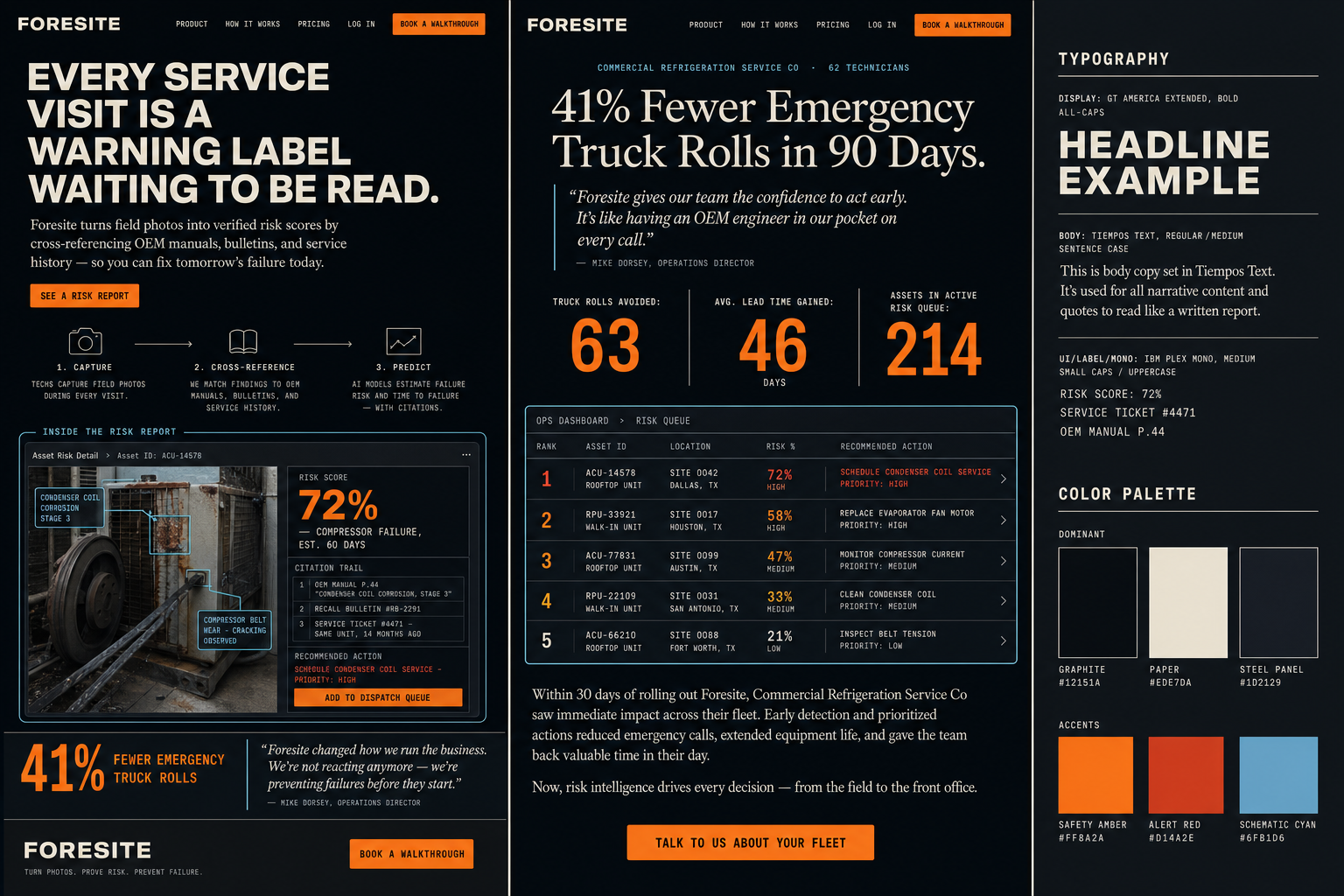
Foresite turns every routine equipment service visit into a predictive maintenance signal. Field technicians (HVAC, commercial refrigeration, restaurant equipment, facilities) snap a photo or short video of equipment during a normal service call. Foresite's vision model scores visible wear, corrosion, and damage, then cross-references that score against a knowledge base of OEM manuals, recall bulletins, and the client's own historical service tickets to generate a time-to-failure risk score — with citations back to the exact manual page or past ticket that informed it.
How it works
- Technician uploads a photo/video via a lightweight mobile app during a normal visit (adds under 30 seconds to existing workflow)
- Vision model flags condition markers: rust, cracked seals, worn belts, discoloration, leaks
- A knowledge-base agent retrieves relevant OEM manual sections, recall notices, and the asset's own service history to contextualize what that condition typically precedes
- Foresite outputs a risk score (e.g. "72% chance of compressor failure within 60 days") with a citation trail, plus a recommended next action
- Every subsequent visit closes the loop: what the asset looked like vs. what actually happened, continuously improving the prediction model — this outcome-linked dataset is the long-term moat
- Ops dashboard lets service companies rank all client assets by failure risk, prioritizing dispatch and quoting proactive repairs instead of emergency truck rolls
MVP scope
- Mobile photo-capture app + simple web dashboard for a single vertical to start (e.g. commercial refrigeration or HVAC service companies)
- Knowledge base seeded from publicly available OEM manuals/spec sheets for common equipment models plus the customer's own uploaded service tickets (CSV/PDF import)
- Vision + LLM agent pipeline (built on current frontier models) delivers condition score + cited risk explanation — no custom ML training required to launch
- Priced as a per-technician monthly SaaS add-on for small-to-mid service companies (10–200 technicians)
Why now
Long-running, agentic frontier models can sustain multi-step reasoning over a growing knowledge corpus and multimodal input without a custom ML team — making it feasible for a tiny team to ship a defensible predictive analytics product that would have required a data science org 18 months ago.
Unique selling points
- Turns an existing zero-cost workflow step (a photo) into a monetizable predictive dataset
- Citations to manuals/history make predictions trustworthy and auditable from day one, avoiding the "black box" trust problem of typical predictive analytics
- Moat compounds automatically: every visit strengthens the outcome-linked training data, making Foresite harder to replicate the longer it operates
- Converts reactive, emergency-driven service businesses into proactive, higher-margin maintenance contracts